
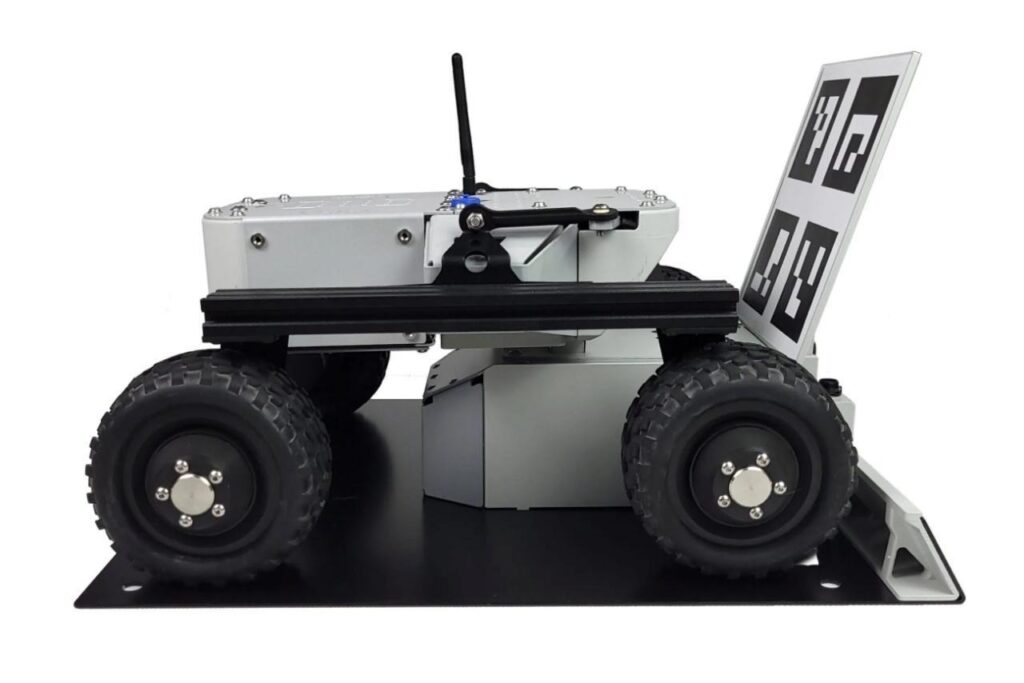
TL;DR: For many labs, a robot for university research is not difficult because wheels, motors, and batteries are unavailable. The difficult part is turning hardware into a stable, documented, reproducible research tool. In academic R&D, ready platforms such as the Leo Rover can help shorten integration work, support ROS 2 based experimentation, and let teams focus on navigation, perception, autonomy, or field methods instead of rebuilding the same base vehicle each semester.
Why does a robot for university research save time in academic R&D?
A robot for university research is usually expected to do more than move. It must carry sensors, expose software interfaces, survive repeated student use, and remain maintainable across grant cycles, thesis projects, and staff turnover. In practice, that makes a research robot platform very different from a classroom kit or a one off prototype.
University teams often start with a reasonable assumption: building an educational robot platform in house may look cheaper and more flexible. For some projects, it is the right technical exercise. But once a lab needs a usable UGV for education and experiments, hidden work appears quickly. Mechanical tolerances, motor control tuning, power distribution, enclosure design, documentation, spare parts, safety procedures, and ROS 2 integration all compete for the same limited engineering hours.
This is where ready mobile robots for research matter in academia. A finished base platform can shorten the path from procurement to first dataset, first autonomous run, or first multi semester student project. That time saving is often more important than the initial hardware bill because university budgets are constrained not only by money, but also by lab staff availability and semester deadlines.
What makes a robot for university research different from a student prototype?
A robot for university research must support repeatability. A student prototype may only need to work for a demo day. A research robot platform must produce consistent behavior across many test sessions, often with different operators and changing payloads.
Several practical requirements usually distinguish a university grade platform:
- Documented interfaces for sensors, compute modules, power, and networking
- Stable software support, often including ROS 2 packages and examples
- Mechanical space and payload options for cameras, LiDAR, GNSS, manipulators, or custom instruments
- Serviceable construction, so damaged parts can be replaced without redesigning the whole chassis
- Reproducibility, so results from one cohort or partner lab can be recreated elsewhere
What an educational robot platform is, in this context, is a shared experimental instrument. It should let a controls group test planners, a perception group validate sensor fusion, and a field robotics team collect outdoor data without each group solving low level vehicle engineering again.
How does a robot for university research reduce integration risk?
The core advantage of a robot for university research from a specialized mobile robotics company is reduced integration risk. In many university projects, delays come from interfaces rather than algorithms. A camera driver conflicts with the onboard computer. Power noise affects GNSS. The drivetrain is mechanically sound, but odometry is not calibrated well enough for mapping tests. These are normal engineering problems, yet they consume weeks.
When Fictionlab delivers platforms such as the Leo Rover, the base system can already address recurring layers that slow down academic work:
- Chassis and drivetrain intended for repeated field use
- Known mechanical mounting points for research payloads
- ROS 2 compatible workflows that fit common lab software stacks
- Remote operation and monitoring paths useful during testing
- Open source friendly architecture that supports modification instead of blocking it
How a research robot platform differs from a generic mobile base is that it is designed to be extended without becoming unstable after the first custom sensor is added. That matters in labs where every project slightly changes the platform configuration.
When is building a robot for university research still the right choice?
A robot for university research should not always be bought as a finished platform. Building from scratch remains technically valid when the base itself is the research subject. Examples include novel suspension systems, custom wheel leg mechanisms, unusual drive topologies, or new powertrain architectures.
In those cases, the vehicle is part of the scientific question. However, many laboratories are not studying chassis design. They are studying autonomy, human robot interaction, agricultural perception, inspection, or multi robot systems. For those teams, spending months reinventing a UGV for education can shift effort away from the actual research objective.
A practical way to decide is to separate infrastructure work from hypothesis driven work. If the lab needs a reliable robot for university research to carry out experiments, a ready platform often aligns better with academic schedules. If the lab is researching mobility hardware itself, custom development may be necessary.
How do ready platforms support budgets and long lab lifecycles?
A robot for university research lives through realities that are familiar in academia: grant start dates, procurement rules, summer turnover, student handovers, and limited technician time. A platform that is easy to understand and maintain is often more valuable than one that is theoretically optimal but poorly documented.
From a budget perspective, universities also need equipment that remains usable over time. The issue is not only purchase price. It is whether the platform can still be operated after a PhD student graduates, whether spare parts are obtainable, and whether incoming students can learn the stack quickly.
That is why an educational robot platform with open documentation and a known software ecosystem is attractive in academic R&D. ROS 2 based workflows, modular payload integration, and serviceable hardware can lower the operational burden on labs that may run the same robot across teaching, thesis work, and funded research.
What does Fictionlab offer universities that need a robot for university research?
Fictionlab focuses on open source mobile robot platforms such as the Leo Rover, relevant to institutions needing a robot for university research rather than a closed black box. The practical value is not that the platform removes engineering work entirely. The value is that it removes repeated baseline work, so university teams can spend more time on the part that is scientifically interesting.
For a lab evaluating an educational robot platform or a UGV for education, the useful questions are usually technical:
- Can the robot carry the target sensors and compute hardware?
- Does the software stack fit ROS 2 based research workflows?
- Can students modify it without breaking maintainability?
- Is the platform suitable for indoor, outdoor, or mixed testing conditions?
- Will it support repeatable experiments across semesters?
These are the conditions under which a research robot platform becomes a productive lab tool. For universities, that often matters more than starting from a blank sheet of paper.
Labs exploring a ready robot for university research can review Fictionlab platforms as examples of how open, field ready mobile systems support academic experimentation without forcing every team to rebuild the foundation first.
More Stories
White-label casino platforms and licensing requirements
Word Counter vs Character Counter: Which One Do You Actually Need?
The Digital Music Revolution: How Mobile Apps Are Unleashing Your Inner Producer