
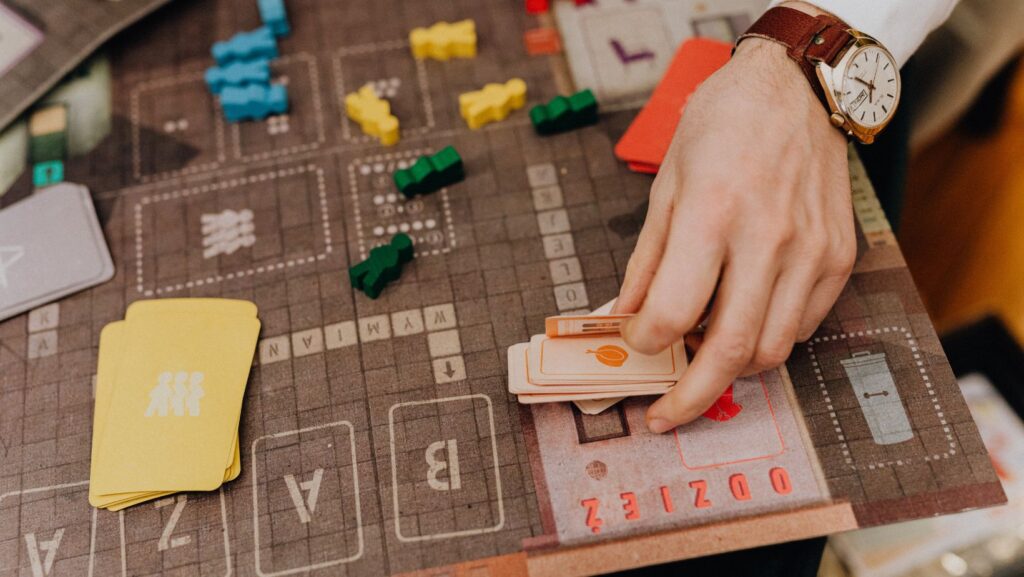
Somewhere between your first tax declaration and your third attempt at choosing a mattress that doesn’t destroy your back, something subtle happens.
You stop going out as much. You begin saying phrases like, “Honestly, I’d rather stay home tonight.”
And then — almost accidentally — a cardboard box appears on your coffee table.
Inside it: wooden meeples.
No one admits it publicly at first. Adults don’t return to board games. That would suggest childhood. Regression. Pajamas before 10pm.
Yet walk into almost any apartment owned by someone over 30 and you’ll find it: a shelf that looks suspiciously like a small toy store.
So what is going on?
The Anti-Digital Rebellion (But Nobody Calls It That)
The funny thing about modern adulthood is that it is strangely intangible.
Your work lives in emails.
Your friendships live in group chats.
Your memories live in a phone backup you pray never corrupts.
By the time you hit your thirties, you realize most of your life exists on glass screens you can’t actually touch.
Board games solve that in a way therapy podcasts cannot.
You shuffle real cards.
You roll real dice.
You physically move pieces and accidentally knock over someone’s carefully planned strategy. (This is, scientifically speaking, 70% of the joy.)
A surprising number of adults describe the same sensation: mental quiet.
When you’re calculating moves in a strategy game, your brain stops thinking about:
- mortgage rates
- unread emails
- whether your lower back pain is “normal aging”
It’s not nostalgia. It’s relief.
The New Social Life: Scheduled Fun
In your twenties, socializing was effortless.
In your thirties, meeting friends requires:
- calendars
- negotiations
- a backup date
Board games fix the biggest adult problem — awkward hanging out.
Without an activity, adult gatherings drift into predictable loops:
work complaints → rent prices → someone’s sleep schedule → everyone goes home early
A board game gives a shared purpose. Silence becomes strategic concentration instead of social failure.
Why it works better than just dinner
- No pressure to maintain constant conversation
- Laughter happens naturally
- Competition replaces small talk
- Everyone participates equally
Suddenly the introvert, the extrovert, and the “I came because my partner made me” person all have a role.
Strategy Is the New Stress Relief
Here’s the twist nobody expected:
Adults don’t just want relaxation anymore — they want structured escape.
Scrolling relaxes your eyes but exhausts your brain.
Board games do the opposite.
You are fully engaged, but not emotionally drained.
The psychological trick
Your brain loves solvable problems.
Life problems:
- career uncertainty
- finances
- aging parents
Board game problems:
- optimize resources
- negotiate alliances
- betray a friend politely
Guess which one your mind prefers on a Thursday evening?
Why This Also Explains Online Gaming Habits

Right around the midpoint of this board-game revival, something interesting appears: overlap with casual online gaming. Not the chaotic multiplayer shooters — the calmer, almost ritualistic games.
People who carefully manage tokens in a tabletop economy often gravitate toward similarly structured digital experiences. That’s partly why titles like Koi Fortune quietly find an adult audience. The appeal isn’t adrenaline — it’s rhythm. Repetition, small rewards, and a predictable system your brain can understand after a long day of unpredictable adult responsibilities. In a strange way, both a cardboard board game and a simple digital mechanic serve the same emotional purpose: control.
And adulthood, more than anything, is a life phase where control feels rare.
The Hidden Benefits Nobody Talks About
Beyond fun, board games quietly repair parts of adult life.
Cognitive benefits
- memory improves
- planning skills sharpen
- attention span returns (slowly, heroically)
Social benefits
- friendships deepen faster than through texting
- couples communicate better
- new people integrate easily into groups
Psychologists sometimes call this parallel engagement: talking while doing something together. Humans bond faster when they collaborate or compete — not when they interview each other over coffee.
Why 30+ Is the Perfect Age
Ironically, board games actually require adulthood to be enjoyable.
You finally have:
- patience
- attention span
- snacks you chose yourself
But more importantly — stakes are low.
At 12 years old, losing a game feels tragic.
At 35, losing is hilarious.
And winning? Winning feels like solving a small, beautiful puzzle with friends as witnesses.
The Real Reason
Adults are not returning to childhood.
They are escaping isolation.
Modern life quietly removed:
- neighborhood gatherings
- spontaneous visits
- shared living spaces
Board games re-create a prehistoric human behavior: sitting around a table solving problems together.
It looks like entertainment.
It is actually community.
So when someone in their thirties says,
“Come over Friday, we’re playing a game,”
What they really mean is:
Let’s pause adulthood for three hours and remember how to be human again.
More Stories
How to Find Quality Gaming News in Your Free Time
A Closer Examination Of Slot Online Game Systems
The Journey Of Online Slots From Classic Machines To Online Platforms